WIPO INTELLECTUAL PROPERTY MOOT COURT COMPETITION 2027: FULLY FUNDED INTERNATIONAL FINALS IN GENEVA, SWITZERLAND.
The World Intellectual Property Organization (WIPO) has opened applications for the 2027 WIPO Intellectual Property (IP) Moot Court Competition, an international legal advocacy competition designed to help university law students develop practical expertise in intellectual property law, legal research, written advocacy and oral argumentation.
WIPO is a specialised agency of the United Nations responsible for promoting intellectual property protection and cooperation worldwide. Its IP Moot Court Competition provides students with an opportunity to examine complex intellectual property disputes, construct legally supported arguments and present their positions in a simulated courtroom before expert judges.
The competition is open to eligible university law students from around the world, including students studying in Nigeria and other African countries.Unlike a conventional scholarship, this programme does not offer general tuition funding. Instead, it provides a competitive international learning experience, with funding for the eight teams that qualify for the final rounds in Geneva, Switzerland.
• Competition: 2027 WIPO IP Moot Court Competition.
• Organiser:World Intellectual Property Organization (WIPO).
• Eligible participants: University law students aged 35 or younger.
• Competition language: English.
• Application period: 12 October to 6 November 2026.
• Geneva finals: 8–10 June 2027.
• Application fee: None.
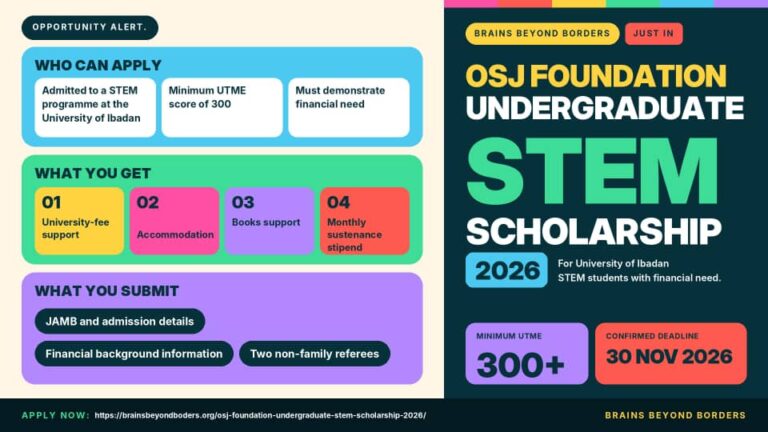 ScholarshipsOsj Foundation Undergraduate STEM Scholarship 2026: Full Scholarship, Accommodation and Monthly Stipend at the University of Ibadan.Nov 24, 2026
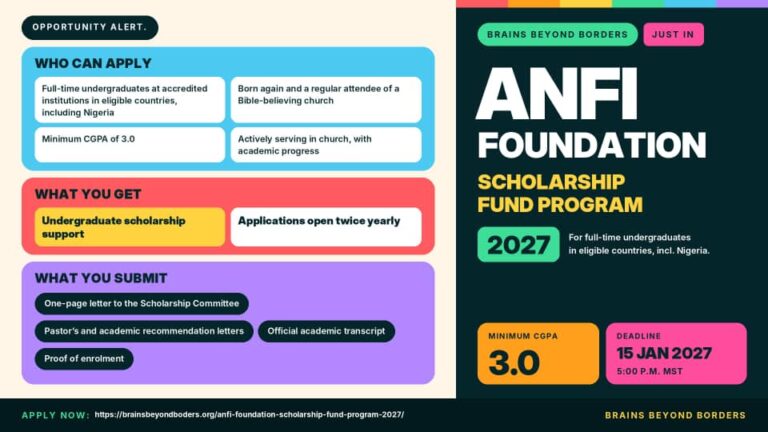 ScholarshipsAnfi Foundation Scholarship Fund Program 2027.Nov 24, 2026
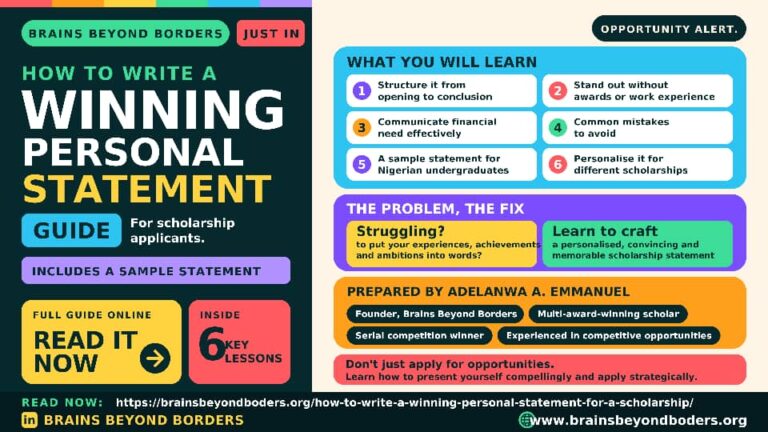 ResourcesHow to Write a Winning Personal Statement for a Scholarship: A Practical Guide with Examples for Students.Nov 23, 2026
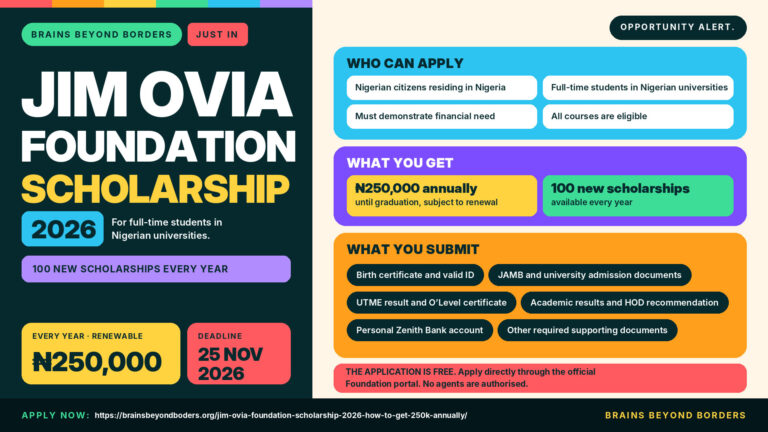 ScholarshipsJim Ovia Foundation Scholarship 2026: How to Get ₦250,000 Annually and Apply Before the Deadline.Nov 23, 2026
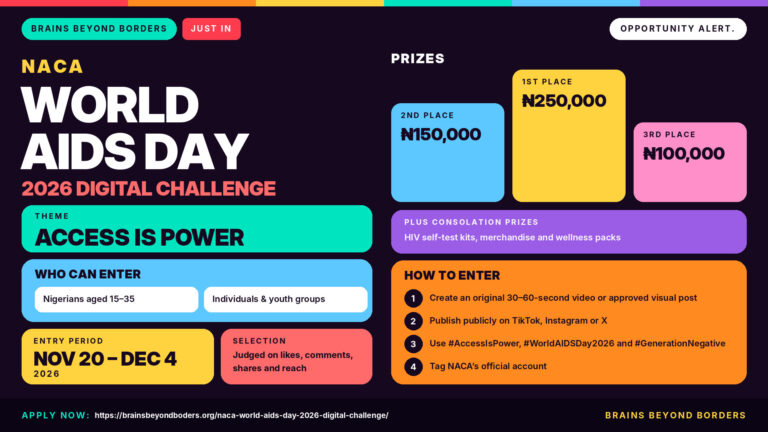 CompetitionsNaca World Aids Day 2026 Digital Challenge: Win ₦250,000 in the Access Is Power Competition.Nov 22, 2026
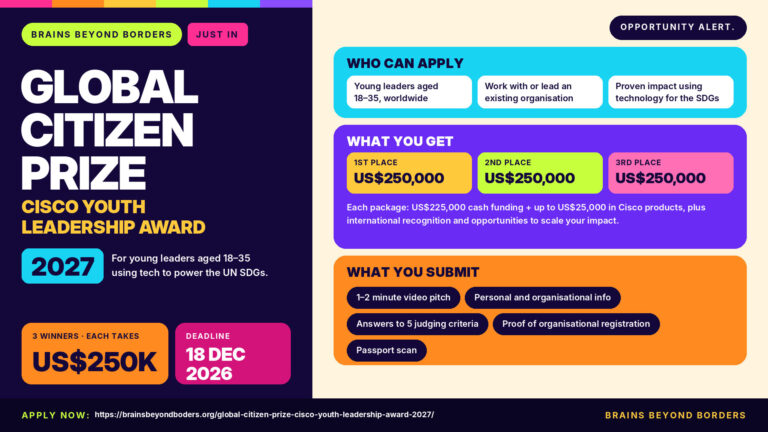 GrantsGlobal Citizen Prize Cisco Youth Leadership Award 2027: Win US$250,000 to Scale Your Impact.Nov 21, 2026
2027 COMPETITION THEME
The 2027 hypothetical dispute explores the intersection of live streaming, intellectual property rights, innovation and online enforcement. Live streaming creates complex legal questions concerning how intellectual property is used, distributed and protected in digital environments. These issues may involve the unauthorised use of protected content, the scope of intellectual property rights, enforcement across digital platforms and the legal responsibilities of relevant parties.
The competition challenges participants to engage with intellectual property law through a hypothetical dispute rather than simply reciting legal principles. Teams must demonstrate their ability to identify relevant legal issues, interpret applicable legal frameworks, develop persuasive arguments and respond to competing positions.
The detailed moot problem is scheduled for release on 10 December 2026, after the initial team-selection stage.
Expires Soon

FCMB TECHNOLOGY GRADUATE TRAINEE PROGRAMME 2026: ELIGIBILITY, BENEFITS AND HOW TO APPLY.
Closing Soon
NATIONAL YOUTH PENSION LITERACY ESSAY COMPETITION 2026: ₦2.5 MILLION IN CASH PRIZES.
Closing Soon
SHE CODE AFRICA FUTURHER AI LITERACY PROGRAMME 2026: FREE AI TRAINING FOR WOMEN IN LAGOS.
Closing SoonWHO CAN APPLY?
The competition is open to eligible university law students worldwide, subject to the following conditions.
1. AGE REQUIREMENT
Both participating students must be 35 years old or younger at the time of application. This age restriction does not apply to the team coach.
2. CURRENT ENROLMENT IN A LAW DEGREE
Each participant must be enrolled in a law degree programme when applying. Students who have completed their coursework but have not yet graduated or been admitted to legal practice may still qualify, provided they satisfy the other requirements.
PhD students may also be eligible if they meet the stated enrolment and qualification conditions.Applicants who have already received a law degree or been admitted to practise law in any jurisdiction are not eligible under the published FAQs.
3. TEAM MEMBERS MUST COME FROM THE SAME UNIVERSITY
Both students must belong to the same university or law school. Teams combining students from different universities are not eligible.The coach, where included, must also be from the same university.
4. PREVIOUS PARTICIPANTS
Students who participated in an earlier edition may apply again if they remain eligible. However, individuals who have won any edition of the competition are not permitted to participate again.
5. INTERNATIONAL ELIGIBILITY
TEAM COMPOSITION
The competition is international rather than restricted to a particular country or region. Eligible students at Nigerian universities and other universities in WIPO Member States may apply, provided they meet the competition requirements.
Each application must be submitted by a university team consisting of:
– Two law students, who will participate as the team’s advocates.
– One coach, optional, who may be another student or a faculty member of the same university.
Only one coach is permitted per team, and the coach must be affiliated with the same university as the participating students.
A university may submit up to two teams. Each team is assessed independently, so the outcome of one application does not determine the outcome of the other.
This means that students interested in participating should coordinate with their colleagues and law faculty early enough to form a suitable team and obtain the necessary institutional approval.
WHAT SUCCESSFUL TEAMS WILL GAIN
1. FUNDED INTERNATIONAL FINALS IN GENEVA
The eight teams that qualify for the final rounds will receive funding from WIPO for:
– Travel to Geneva, Switzerland.
– Accommodation during the final rounds.
– Visa fees.
The finals will take place at WIPO Headquarters in Geneva from 8 to 10 June 2027.
Important funding limitation: WIPO’s published FAQs state that coaches will not be funded. Participants must arrange their own passports and visa applications. WIPO will provide official support letters and cover the required visa fees, but additional costs associated with obtaining a visa may remain the participants’ responsibility.
Funding is reserved for the eight teams that qualify for the Geneva finals. Applicants should not assume that all teams applying or participating in the earlier online rounds will receive travel funding.
2. PRACTICAL INTELLECTUAL PROPERTY LAW EXPERIENCE
Participants will engage with a hypothetical intellectual property dispute and develop arguments based on relevant legal principles, legislation, treaties and other legal authorities.This experience can help students strengthen their understanding of how intellectual property law applies to emerging technologies and commercial activity.
3. WRITTEN AND ORAL ADVOCACY
The competition is designed to develop skills in:
– Legal research and analysis.
– Written legal argumentation.
– Oral advocacy and courtroom presentation.
– Critical thinking and structured reasoning.
– Responding to counterarguments.
– Professional communication and teamwork.
4. INTERNATIONAL EXPOSURE
The competition connects participants with law students, legal experts, judges and other individuals interested in intellectual property law from different parts of the world.
For students considering careers in intellectual property, technology law, commercial law, legal research or international legal practice, the competition offers a valuable opportunity to engage with contemporary legal questions in an international setting.
HOW THE SELECTION PROCESS WORKS
The competition has several stages.
STAGE 1: VIDEO APPLICATION
Teams submit an online application and a short, pre-recorded legal argument responding to the question set out in the official application guidelines. The video is used to assess the team’s legal reasoning, understanding of intellectual property issues, persuasiveness and presentation.
STAGE 2: SELECTION OF TEAMS
WIPO will announce the selected teams on 30 November 2026.
STAGE 3: RELEASE OF THE MOOT PROBLEM
The detailed hypothetical case will be released on 10 December 2026. Teams will then prepare for the subsequent written and oral stages.
STAGE 4: WRITTEN SUBMISSIONS
The deadline for written submissions is 1 February 2027.
Teams must analyse the case and develop written arguments in accordance with the competition rules and instructions provided by WIPO.
STAGE 5: ONLINE ROUNDS
The online rounds are scheduled for 1–12 March 2027.
The precise organisation of the virtual oral rounds may depend on the number and distribution of participating teams. WIPO will provide selected teams with further information.
STAGE 6: INTERNATIONAL FINALS IN GENEVA
The eight teams that qualify for the finals will compete in Geneva, Switzerland.
The schedule is:- 8 June 2027: Quarter-finals.
– 9 June 2027: Semi-finals.
– 10 June 2027: Grand finale and awards.
Expires Soon
FCMB TECHNOLOGY GRADUATE TRAINEE PROGRAMME 2026: ELIGIBILITY, BENEFITS AND HOW TO APPLY.
Closing Soon
NATIONAL YOUTH PENSION LITERACY ESSAY COMPETITION 2026: ₦2.5 MILLION IN CASH PRIZES.
Closing Soon
SHE CODE AFRICA FUTURHER AI LITERACY PROGRAMME 2026: FREE AI TRAINING FOR WOMEN IN LAGOS.
Closing SoonHOW TO APPLY
Applications are submitted through WIPO’s official online application form. Applicants must also submit the required video separately through the designated upload link.
STEP 1: FORM A TEAM
Identify two eligible law students from the same university. You may also identify one eligible coach from the same institution. Confirm that both students satisfy the age and enrolment requirements.
STEP 2: READ THE OFFICIAL APPLICATION GUIDELINES
Review the application guidelines, FAQs and declaration form before beginning the application. These documents explain the eligibility rules, required video format, content requirements and submission procedure.
STEP 3: COMPLETE THE ONLINE APPLICATION FORM
Open the official application form HERE.
The form covers eight sections:
1. Declarations and consent statements.
2. University or law school information.
3. First team member’s information.
4. Second team member’s information.
5. Coach information, where applicable.
6. Dean of Students or faculty representative details.
7. Upload of the completed declaration form.
8. Other requested information.
All required declarations and consent statements must be accepted for the application to be eligible.
STEP 4: COMPLETE THE DECLARATION FORM
• Download the official declaration form HERE.
The form must be completed and signed by both team members, the coach if applicable, and the Dean of Students or faculty representative of the participating university or law school.Upload the signed form through the online application form.
STEP 5: PREPARE THE REQUIRED VIDEO
Teams must prepare a pre-recorded legal argument of no more than five minutes, responding to one of the questions in the official application guidelines. The 2027 application exercise presents a hypothetical scenario involving a stationery company, Artstation, which sells agendas branded around a distinctive sandalwood and jasmine fragrance. The company is considering intellectual property protection for the product.
Teams must address one of these questions:
– What form of intellectual property protection could the company consider for the perfumed agendas?
– What challenges might the company encounter in seeking protection for the smell associated with the product?
The video must include the following six elements:
1. Team introduction: Introduce both students and identify their respective roles.
2. Issue overview: State the legal question and the team’s position.
3. Legal framework: Identify relevant national or regional laws, international treaties, case law or other applicable legal authorities.
4. Substantive legal arguments: Present at least two core arguments supporting the team’s position.
5. Counterarguments: Identify at least one counterargument and explain the team’s response.
6. Conclusion: Summarise the principal arguments clearly and logically.Both team members must participate in the video.
STEP 6: FOLLOW THE VIDEO TECHNICAL REQUIREMENTS
The official guidelines specify the following requirements:
– Language: English.
– Maximum duration: Five minutes.
– Playback speed: Normal speed, 1.0×.
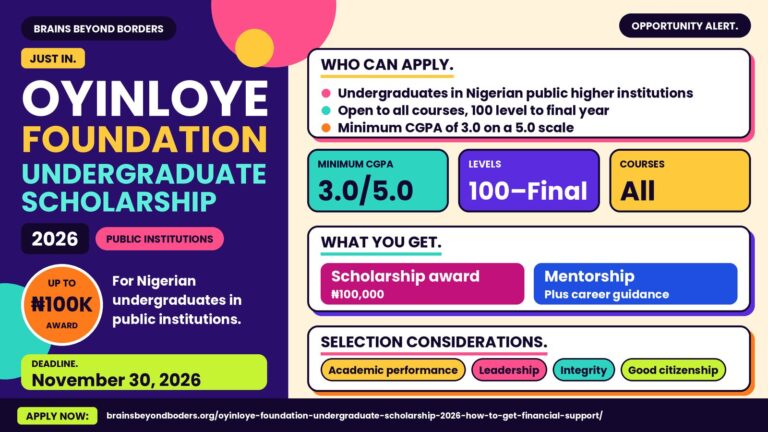 ScholarshipsOyinloye Foundation Undergraduate Scholarship 2026: How to Get ₦100,000 in Financial Support.Nov 21, 2026
 AI ToolsMicrosoft Datacenter Academy Skilling Bootcamp 2027: 12 Weeks of Free Training in Cloud Computing, AI Infrastructure and Networking.Nov 20, 2026
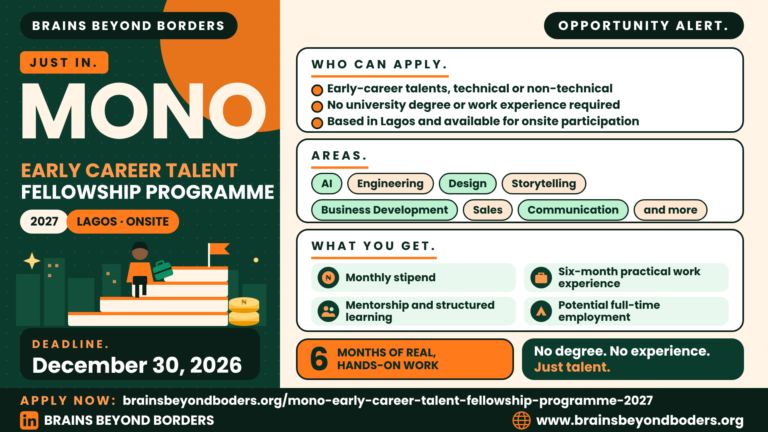 FellowshipsMono Early Career Talent Fellowship Programme 2027: Apply for a 6-Month Fellowship with Monthly Stipend in Lagos.Nov 20, 2026
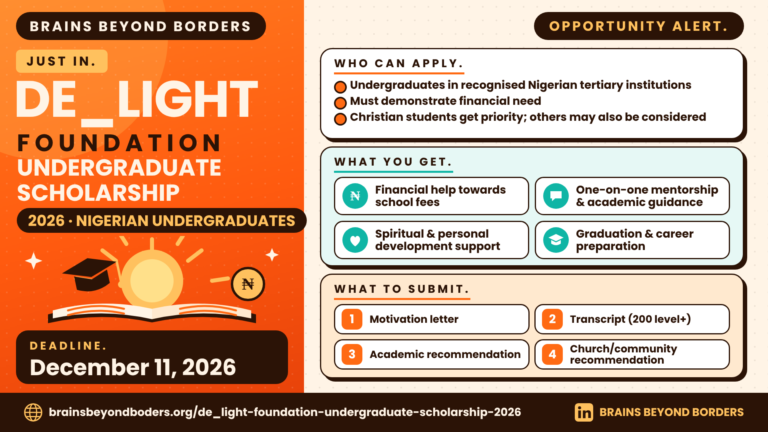 ScholarshipsDe_Light Foundation Undergraduate Scholarship 2026: Financial Support and Mentorship for Nigerian Students.Nov 18, 2026
 Scholarships2027 ADSIF JAMB Registration Scholarship: How to Get Your JAMB Fee Fully Sponsored.Nov 18, 2026
 Free Training ProgrammesShe Leads Africa Boosther Program 2026: Free Digital Skills Training, Mentorship and Career Development for Young Nigerian Women.Nov 18, 2026
– Accepted file formats: MP4 or MOV.
– Maximum file size: 400 MB.
– File naming convention: University name, country and both speakers’ surnames.
Videos exceeding five minutes will not be reviewed beyond the time limit. Accelerated or otherwise edited videos that alter the natural pace of the presentation will not be accepted.
WIPO also advises teams to present as if addressing a court rather than reading directly from a script. Formal legal language, structured reasoning, professional delivery and clear analysis are important.
STEP 7: SUBMIT THE VIDEO SEPARATELY
The video must be uploaded through WIPO’s designated Tresorit submission link which can be access HERE.
Submitting the online application form alone does not complete the process. Follow the separate video-submission instructions and ensure that both parts are submitted.
STEP 8: REVIEW AND SUBMIT BEFORE THE DEADLINE
Check that the online form is complete, the declaration is properly signed, and the video meets all requirements. The application form allows applicants to save their progress and resume later using the “Save and Continue” function.
There is no application or registration fee.
HOW THE VIDEO WILL BE EVALUATED
According to WIPO’s application guidelines, video submissions are assessed using five criteria:
– Understanding of legal issues: 30%.
The depth of the team’s knowledge of industrial property law and its application.
– Clarity and structure of argument: 20%.
The organisation, coherence and logical flow of the presentation.
– Persuasiveness: 20%.
The effectiveness of the arguments in convincing the judges.
– Use of legal frameworks and authorities: 20%.
The accuracy and relevance of references to legislation, treaties, case law and other legal authorities.
– Professionalism and presentation: 10%.
Courtroom-style delivery, confidence and teamwork.Because legal understanding carries the highest individual weighting, teams should prioritise sound legal analysis rather than relying solely on presentation style.
IMPORTANT DATES
All times are given in Geneva time, as stated in WIPO’s official competition schedule.
• Applications open: 12, October 2026.
• Application deadline: 6 November 2026, 23:59 Geneva time.
• Announcementof selected teams: 30 November 2026.
• Release of the moot problem: 10 December 2026.
• Deadline for clarification requests: 17 December 2026.
• Responses to clarification requests: 15 January 2027.
• Written submissions deadline: 1 February 2027.
• Online rounds: 1–12 March 2027.
• Quarter-finals in Geneva: 8 June 2027.
• Semi-finals in Geneva| 9 June 2027.
• Grand finale and awards: 10 June 2027.
IMPORTANT NOTES FOR APPLICANTS
– The competition is for teams, not individual applicants.
– Both students must be enrolled in a law degree and satisfy the age requirements.
– Team members and any coach must belong to the same university.
– Up to two teams from one university may apply.
– Both students must participate in the video.
– The declaration form must carry the required signatures.
– The video must be submitted separately from the online application form.
– Only the eight teams qualifying for the Geneva finals receive the stated travel, accommodation and visa-fee funding.
– Coaches are not funded for the Geneva finals.
– There is no application fee.
– Applicants should rely on WIPO’s official materials if any third-party summary differs from the published requirements.
Expires Soon
FCMB TECHNOLOGY GRADUATE TRAINEE PROGRAMME 2026: ELIGIBILITY, BENEFITS AND HOW TO APPLY.
Closing Soon
NATIONAL YOUTH PENSION LITERACY ESSAY COMPETITION 2026: ₦2.5 MILLION IN CASH PRIZES.
Closing Soon
SHE CODE AFRICA FUTURHER AI LITERACY PROGRAMME 2026: FREE AI TRAINING FOR WOMEN IN LAGOS.
Closing SoonOFFICIAL APPLICATION LINKS
• Access The Official competition webpage HERE.
• Access The Direct online application form HERE.
• Access The Oficial application guidelines HERE.
• Access The Official FAQs HERE.
• Access The Declaration form HERE.
• Access The separate video submission portal HERE.
• Enquiries: [email protected].
• Application deadline: 6 November 2026, 23:59 Geneva time.
Eligible law students should review the official documents, form a team and prepare their application well before the deadline.
Join the Brains Beyond Borders Community
Get scholarships, tips and updates wherever you are.