PAN-AFRICA POLICY CHALLENGE 2026: 5 POWERFUL REASONS AFRICAN UNDERGRADUATES SHOULD ENTER.
The Pan-Africa Policy Challenge 2026 is inviting undergraduate students across Africa to develop practical, evidence-informed policy recommendations addressing one of the continent’s persistent agricultural challenges: post-harvest food losses.
Organised in partnership by Innovations for Poverty Action (IPA) and the African Economic Scholars Program (AESP), the competition challenges students to examine why so much agricultural produce is lost between harvest and the market, and what African governments and regional institutions can do to address the problem.
Under the theme “Producing More, Losing More? Addressing Post-Harvest Losses in African Food Systems,” participants are expected to select a specific agricultural commodity and value chain in an African country, investigate the scale and economic consequences of post-harvest losses, identify the underlying challenges and propose realistic policy interventions.
 ScholarshipsOsj Foundation Undergraduate STEM Scholarship 2026: Full Scholarship, Accommodation and Monthly Stipend at the University of Ibadan.Nov 24, 2026
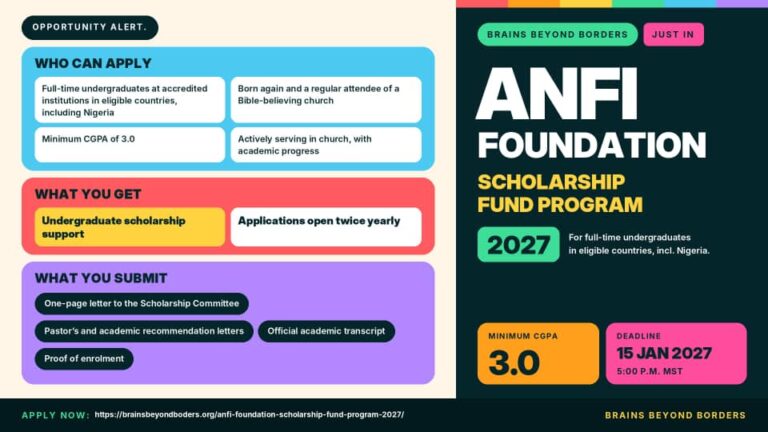 ScholarshipsAnfi Foundation Scholarship Fund Program 2027.Nov 24, 2026
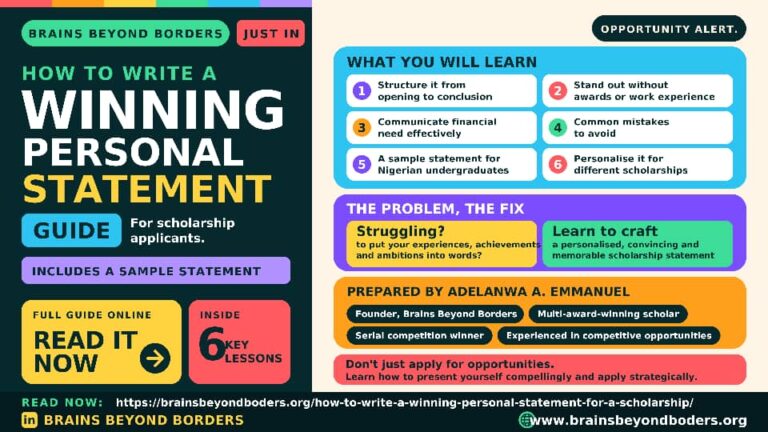 ResourcesHow to Write a Winning Personal Statement for a Scholarship: A Practical Guide with Examples for Students.Nov 23, 2026
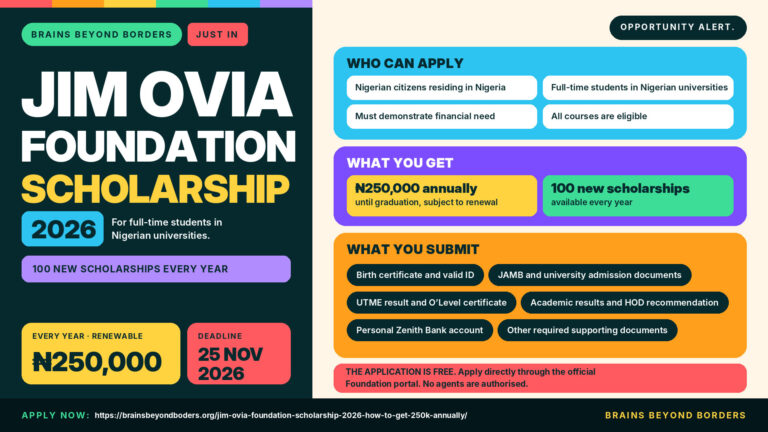 ScholarshipsJim Ovia Foundation Scholarship 2026: How to Get ₦250,000 Annually and Apply Before the Deadline.Nov 23, 2026
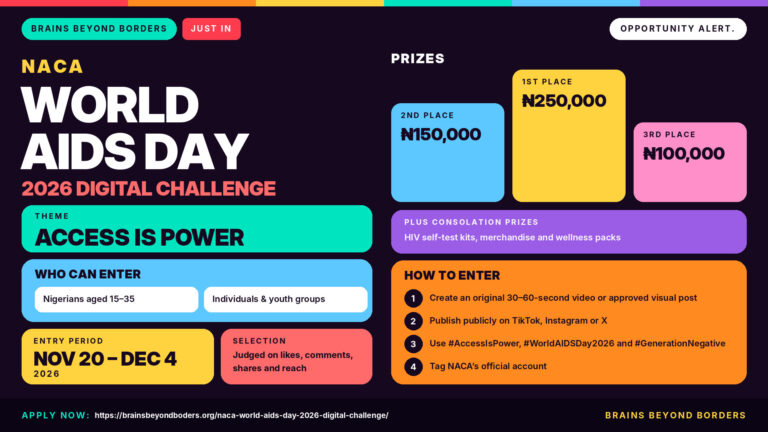 CompetitionsNaca World Aids Day 2026 Digital Challenge: Win ₦250,000 in the Access Is Power Competition.Nov 22, 2026
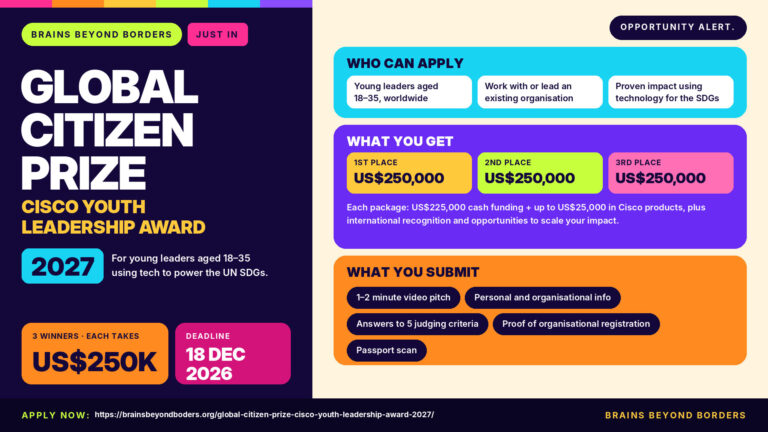 GrantsGlobal Citizen Prize Cisco Youth Leadership Award 2027: Win US$250,000 to Scale Your Impact.Nov 21, 2026
You do not have to be an agriculture student to participate. The announcement invites undergraduates across Africa, making this an opportunity for students interested in economics, public policy, agriculture, development, research, food security and related fields.
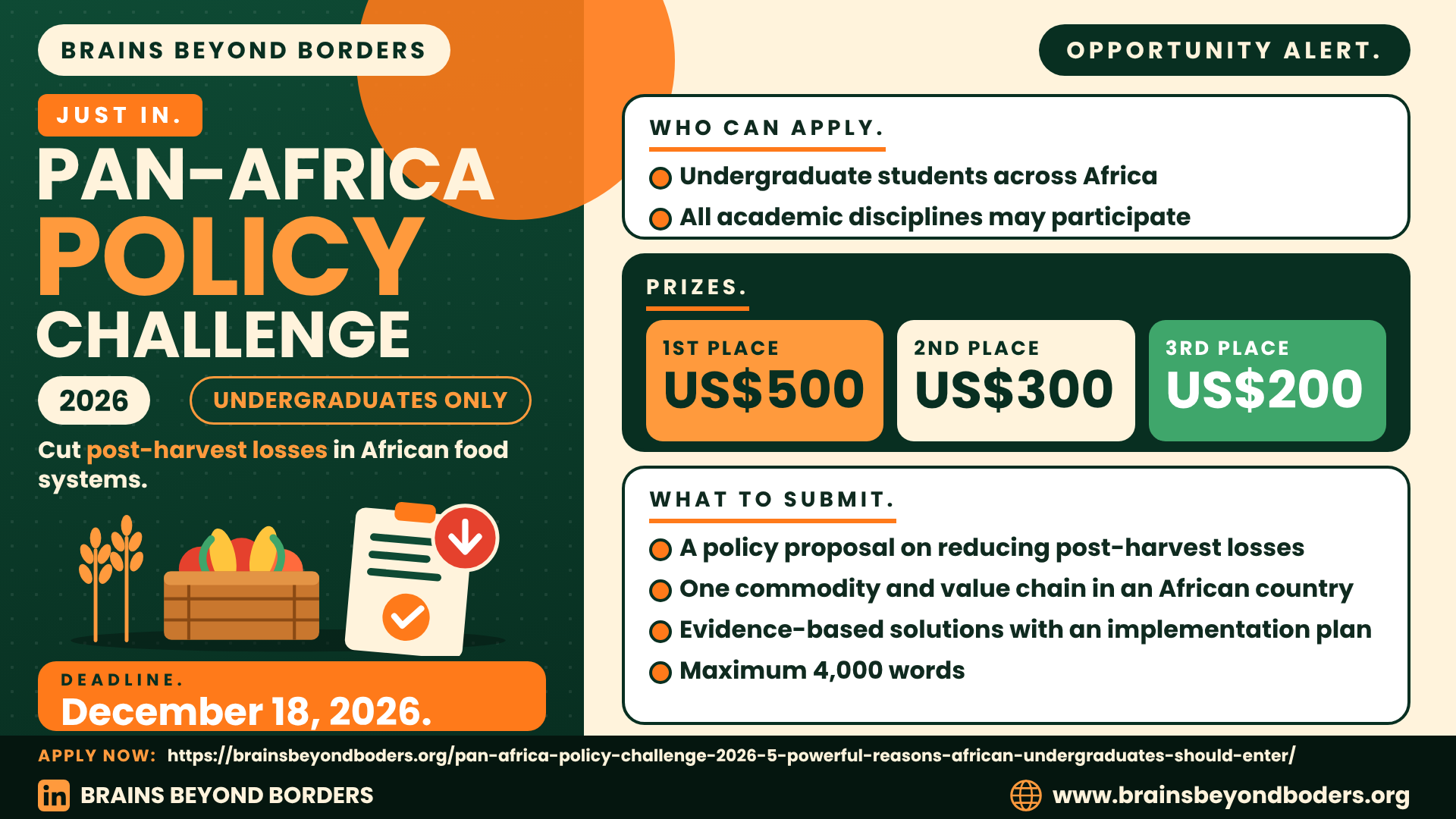
The competition offers cash prizes of US$500 for first place, US$300 for second place and US$200 for third place. Entries must not exceed 4,000 words and must be submitted by Friday, 18 December 2026.
If you are interested in African development and want to demonstrate your ability to turn research into practical policy recommendations, this is an opportunity worth considering.
1. What is the Pan-Africa Policy Challenge 2026?
The Pan-Africa Policy Challenge is a policy-focused writing competition organised by Innovations for Poverty Action (IPA) in partnership with the African Economic Scholars Program (AESP).
The competition provides undergraduate students with an opportunity to examine an important development challenge affecting African countries and propose evidence-based solutions that governments and institutions can implement. For its 2026 edition, the organisers have selected post-harvest losses in African food systems as the central subject.
The challenge is built around a practical question: how can African governments and regional policy institutions develop scalable, market-driven interventions in infrastructure, cold-chain logistics and post-harvest technology to reduce food losses, improve smallholder farmers’ incomes and strengthen food security?
This means your submission should go beyond describing the problem. You are expected to investigate a particular agricultural value chain and develop recommendations that respond to its actual challenges.
2. Why is the competition focusing on post-harvest food losses?
Africa’s agricultural challenge is not limited to producing enough food. Another important problem is ensuring that the food already produced reaches consumers in good condition. Post-harvest losses occur when agricultural produce is lost in quantity or quality after harvesting and before it reaches the retail stage. These losses can occur during handling, drying, storage, transportation, processing and distribution.
For example, a farmer may successfully harvest tomatoes, but inadequate storage, poor transportation or delays in reaching buyers can cause a significant portion of the produce to spoil before it is sold. Similarly, grains may be damaged by poor drying and storage practices, pests or inadequate protection from moisture.
The consequences extend beyond wasted food. Farmers may lose the income they expected from their harvest, traders may incur additional costs, consumers may face reduced availability of produce, and countries may lose valuable agricultural resources.
3. How serious is the post-harvest loss problem in Africa?
The Food and Agriculture Organization of the United Nations (FAO) reports that approximately 23% of food was lost in sub-Saharan Africa in 2023 across the stages from post-harvest on-farm activities through transportation, storage, wholesale and processing. This was the highest regional estimate reported in its 2023 data.
The figure is a regional estimate, not a claim that every crop or country experiences the same loss rate. The scale of losses varies according to the commodity, location and stage of the supply chain. In many African communities, inadequate storage facilities, limited cold-chain infrastructure, poor roads, insufficient processing capacity and weak market connections contribute to the problem.
The issue is particularly important for smallholder farmers, who may lack the financial resources and infrastructure required to preserve their produce or transport it efficiently to markets. The competition therefore asks students to consider how policy decisions, investment and market-based solutions can reduce these losses.
4. What is the theme of the Pan-Africa Policy Challenge 2026?
The 2026 theme is: “Producing More, Losing More? Addressing Post-Harvest Losses in African Food Systems.”
The theme challenges you to think beyond agricultural production. Increasing the quantity of food produced does not automatically guarantee better food availability or higher farmer incomes. If a significant proportion of that produce is lost before reaching the market, the benefits of increased production are reduced. The organisers want participants to examine how African countries can strengthen the systems that connect farmers to markets and ensure that more of what is harvested is preserved, transported, processed and sold.
5. What question must your policy proposal answer?
Your submission should respond to the central policy question: How can African governments and regional policy institutions design and implement scalable, market-driven interventions in infrastructure, cold-chain logistics and post-harvest technology to drastically reduce food loss, thereby boosting smallholder farmer incomes and strengthening continental food security?
This question provides the direction for your policy proposal.You should consider the specific conditions of the country and agricultural value chain you select. A solution that works for fresh vegetables may not be appropriate for maize, cassava, fish or other agricultural products.
Your recommendations should therefore be supported by evidence and designed around the actual challenges affecting your chosen value chain.
6. Who is eligible for the Pan-Africa Policy Challenge 2026?
According to the competition announcement, the challenge is open to:
• Undergraduate students across Africa.
• Students interested in research, economics, public policy, agriculture, development and food security.
The announcement does not restrict participation to students studying a particular academic discipline. Therefore, if you are an undergraduate studying in Nigeria, Ghana, Kenya, Uganda, South Africa or another African country, you may be eligible to participate.
Important:
The published announcement does not provide a detailed breakdown of eligible academic levels, age restrictions, nationality requirements or whether students must submit individually or in teams. Check the official application form for any additional conditions before submitting.
7. What are the prizes for the Pan-Africa Policy Challenge 2026?
The competition offers cash prizes to the three highest-placed entries.
Position: | Cash prize: |
| First place: | US$500. |
| Second place: | US$300. |
| Third place: | US$200. |
The prize amounts are stated in US dollars. The announcement does not specify additional benefits such as travel support, publication, certificates or mentorship, so these should not be assumed.
8. What are the requirements for the Pan-Africa Policy Challenge 2026?
Your submission must address the competition theme and satisfy the instructions provided by the organisers. The announcement specifies a maximum word limit of 4,000 words.
More importantly, your policy proposal must demonstrate the following five elements.
1. Select a specific agricultural commodity and value chain.
You must choose a particular agricultural commodity and examine its value chain in an African country.
A value chain refers to the different activities and participants involved in producing, handling, processing, transporting and marketing an agricultural product. For example, you could investigate:-
• Tomato production and distribution in Nigeria.
• Maize harvesting, drying and storage in Ghana.
• Cassava processing and marketing in Nigeria.
• Mango transportation and storage in Kenya.
Fish handling and preservation in Uganda. These are illustrative examples, not a list of topics prescribed by the organisers. The important thing is to avoid discussing post-harvest losses across the entire African agricultural sector without a clear focus. Select a specific commodity and location so that your investigation can be sufficiently detailed.
2. Use credible evidence to establish the scale and economic costs of the losses.
You must establish how serious the problem is in your selected value chain.This requires credible information showing:
• The quantity or proportion of produce being lost.
Where the losses occur.
• The economic cost to farmers and other stakeholders.
• The consequences for food availability and market supply.
For example, if you select tomatoes in Nigeria, you should investigate available evidence on losses during harvesting, handling, transportation, storage or marketing. Avoid presenting estimates without reliable sources. Your statistics should be traceable to credible research, government publications, agricultural institutions or other dependable evidence.
3. Identify the underlying market, institutional or policy constraints.
After establishing the problem, explain why it persists.Possible constraints include inadequate storage facilities, unreliable electricity, poor transportation networks, limited access to financing, insufficient processing facilities, weak market connections and gaps in agricultural policies.
However, do not simply list every possible challenge.Identify the constraints that actually affect your selected commodity and location, and support your explanation with evidence.
4. Develop practical, evidence-informed policy interventions.
This is one of the most important parts of your submission. You must recommend solutions that address the problems you have identified. Depending on your chosen value chain, possible interventions could include:
• Investment in appropriate storage infrastructure.
• Solar-powered cold-storage facilities for perishable produce.
• Improved transportation and distribution systems.
• Access to affordable post-harvest technologies.
• Better processing and packaging facilities.
• Stronger market connections between farmers and buyers.
• Agricultural financing arrangements that support post-harvest investment.
These are possible approaches, not compulsory recommendations. Your proposal should explain why your chosen interventions are suitable, how they would work and what evidence supports them.
5. Include a practical implementation plan.
Your proposal must explain how the recommended policies would be implemented.
The organisers specifically require an outline covering:
• Responsible stakeholders: The institutions, organisations or groups responsible for implementation.
• Resources: The funding, infrastructure, technology and human resources required.
• Timing: The proposed implementation schedule.
• Indicators of success: How progress and results will be measured.
For example, if you recommend establishing community-based cold-storage facilities, your implementation plan should identify the relevant government agencies, private-sector partners or farmer organisations, explain the resources required, provide a realistic timeline and establish how reductions in food losses would be measured. A recommendation without an implementation plan is incomplete for this challenge.
9. How many words should your policy proposal contain?
The maximum word limit is 4,000 words. This means your submission must not exceed 4,000 words. The announcement does not state a minimum word count. It is therefore advisable to focus on producing a well-researched, coherent and sufficiently detailed policy proposal rather than adding unnecessary content simply to increase the word count.
Your writing should communicate the problem, evidence, proposed interventions and implementation plan clearly.
10. How to apply for the Pan-Africa Policy Challenge 2026:
The competition announcement directs participants to submit their entries through a Google Form.
Follow these steps:
1. Read the competition requirements:
Understand the theme, central policy question and five elements your submission must address.
2. Choose your agricultural value chain:
Select a specific commodity and an African country to investigate.
3. Research the problem:
Gather credible evidence on the scale, location and economic consequences of post-harvest losses.
4. Develop your policy recommendations:
Identify the underlying constraints and propose practical interventions supported by evidence.
 FellowshipsMono Early Career Talent Fellowship Programme 2027: Apply for a 6-Month Fellowship with Monthly Stipend in Lagos.Nov 20, 2026
 DuelsMonica ₦50 Million Creator Challenge 2026: The Guide for You to Apply and Win .Nov 20, 2026
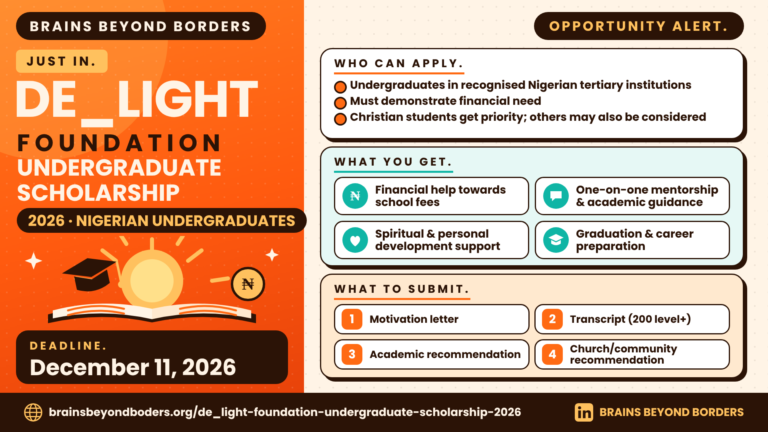 ScholarshipsDe_Light Foundation Undergraduate Scholarship 2026: Financial Support and Mentorship for Nigerian Students.Nov 18, 2026
 Scholarships2027 ADSIF JAMB Registration Scholarship: How to Get Your JAMB Fee Fully Sponsored.Nov 18, 2026
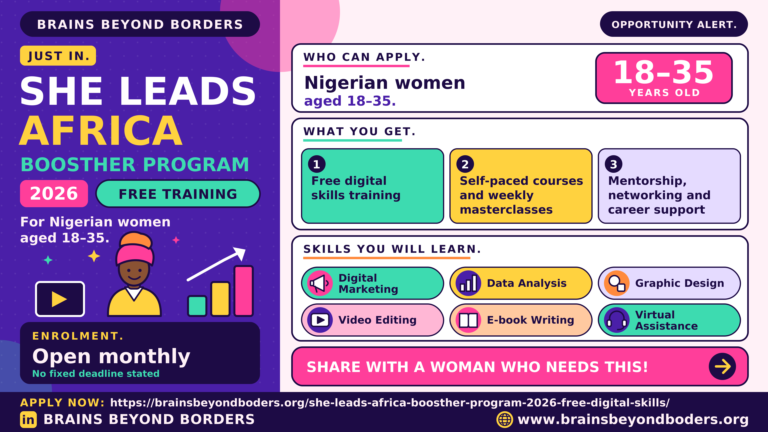 Free Training ProgrammesShe Leads Africa Boosther Program 2026: Free Digital Skills Training, Mentorship and Career Development for Young Nigerian Women.Nov 18, 2026
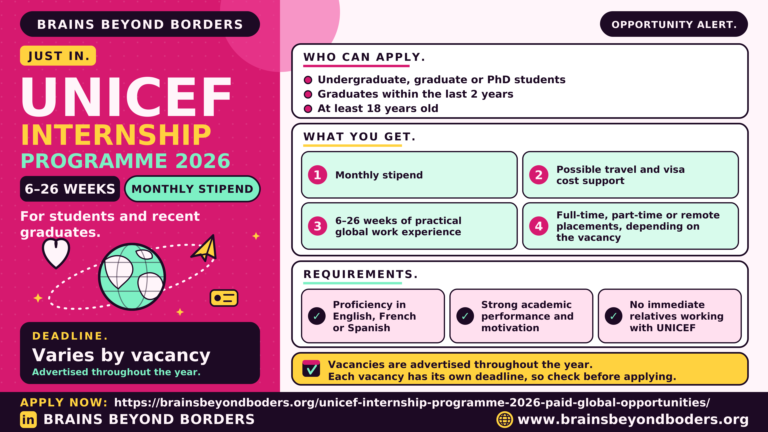 Research & Internships ( Fully Funded )UNICEF Internship Programme 2026: Paid Global Opportunities for Students and Recent Graduates.Nov 18, 2026
5. Prepare your implementation plan:
Specify the responsible stakeholders, resources, timeline and indicators of success.
6. Review your submission:
Ensure that your proposal addresses the competition question and does not exceed 4,000 words.
7. Complete the application form:
Provide the information requested and submit your entry through the official Google Form.
The QR code on the competition flyer also directs applicants to this form. The published announcement does not provide a separate list of mandatory supporting documents or specify a particular file format. Follow the instructions in the form carefully.
When is the Pan-Africa Policy Challenge 2026 deadline?
The submission deadline is Friday, 18 December 2026.
You should complete your policy proposal and submit it before the closing date. Do not leave your research, writing and application until the final day. A policy proposal of this nature requires time to identify a suitable value chain, find reliable evidence, develop recommendations and prepare a realistic implementation plan. The competition announcement does not specify a closing time or time zone. If the application form provides additional deadline instructions, follow those instructions.
How to develop a strong entry for the Pan-Africa Policy Challenge:
Although the organisers have outlined what your submission should contain, the quality of your research and recommendations will determine how effectively you address the challenge.
Here are some practical considerations as you prepare your entry.
Choose a problem you can investigate properly. Do not select a commodity simply because it sounds interesting. Choose one for which you can find credible information about production, post-harvest handling, market access and the causes of losses. A clearly defined problem will make it easier to develop a focused proposal.
Use country-specific evidence. Africa is not a single agricultural market. The infrastructure, production systems, policies and challenges affecting farmers differ across countries and regions. If you choose Nigeria, for instance, your recommendations should reflect the relevant Nigerian agricultural and market conditions.
Avoid applying statistics from another country to your chosen location without explaining why the comparison is relevant.
Make your recommendations realistic. A policy proposal should not merely recommend that governments invest more money or build more facilities. Explain what should be done, who should do it, how it should be funded and why the intervention is appropriate.
Consider whether smallholder farmers can realistically access and afford the proposed solution.
Explain how success will be measured. Your implementation plan should include measurable indicators. Depending on your proposal, these could include:
• Reduction in the percentage of produce lost.
• Increase in the quantity reaching markets.
• Changes in farmers’ net income.
• Number of farmers accessing improved storage facilities.
• Reduction in transportation or storage-related losses.
Choose indicators that directly reflect the objectives of your proposed intervention.
Keep your argument evidence-informed. Use credible sources and connect your evidence to your recommendations. The purpose is not simply to demonstrate that you know post-harvest losses are a problem. You must show that you understand the specific problem you have selected and can develop a policy response that is practical and defensible.
Why should you participate in the Pan-Africa Policy Challenge?
The competition offers more than the opportunity to win a cash prize. It provides a platform to develop and demonstrate skills relevant to research, economics, public policy and development.
• You can strengthen your policy research skills: Investigating a specific agricultural value chain will require you to identify credible sources, examine evidence and understand the economic implications of a development problem.
• You can develop practical policy-writing experience: You will need to move beyond describing a problem and develop recommendations that institutions can potentially implement.
• You can demonstrate your understanding of African development challenges: Food security, agricultural productivity, farmers’ incomes and market infrastructure are important development issues across the continent.
• You can compete for cash prizes: The top three entries will receive US$500, US$300 and US$200, respectively. For students considering careers in economics, public policy, research, international development, agriculture or related fields, the experience of preparing a structured policy proposal can also be valuable.
Frequently asked questions about the Pan-Africa Policy Challenge 2026
Is the Pan-Africa Policy Challenge 2026 open to Nigerian students?
Yes. The competition is open to undergraduate students across Africa, so Nigerian undergraduates are within the announced target audience.
Must I study economics or agriculture to participate?
The announcement does not specify a compulsory academic discipline. It invites undergraduates across Africa, particularly those interested in research, economics and public policy.
Can students from other African countries apply?
Yes. The announcement describes the competition as open to undergraduates across Africa.
What is the maximum word count?
Your submission must not exceed 4,000 words. No minimum word count is stated in the announcement.
What topic should I write about?
Your submission must address post-harvest losses in African food systems. You should select a specific agricultural commodity and value chain in an African country and develop evidence-informed policy recommendations.
Can I write about post-harvest losses in Nigeria?
Yes. Nigeria is an African country, and you can select a Nigerian agricultural commodity and value chain for your investigation.
How much can I win?
First place receives US$500, second place receives US$300, and third place receives US$200.
How do I submit my entry?
Entries are submitted through the competition’s Google Form.
When is the application deadline?
The deadline is Friday, 18 December 2026.
Final thoughts:
Post-harvest losses represent more than an agricultural inconvenience. They affect farmers’ earnings, food availability, market efficiency and the ability of African countries to build resilient food systems.
The Pan-Africa Policy Challenge 2026 gives undergraduate students an opportunity to examine this problem and contribute practical ideas for addressing it.If you are interested in research, economics, public policy or African development, consider participating. Choose a specific agricultural value chain, investigate the evidence, understand the constraints and develop recommendations that can realistically be implemented.
Your task is not simply to explain why food is being lost. It is to show how better policies can help ensure that more of what African farmers produce reaches the people and markets that need it.
DEADLINE: Friday, 18 December 2026.