MILLENNIUM FELLOWSHIP 2027: GLOBAL LEADERSHIP FELLOWSHIP FOR UNDERGRADUATES.
The Millennium Fellowship is a semester-long leadership development programme presented by the United Nations Academic Impact (UNAI) and the Millennium Campus Network (MCN). It supports undergraduate students who want to turn ideas for social change into practical projects that address challenges in their campuses and communities.
The programme focuses on student leadership, collaborative action and the United Nations Sustainable Development Goals (SDGs). Rather than simply attending lectures, selected Fellows work on a defined social-impact project, learn alongside other student leaders and apply their training to real-world challenges.
Applications are now open for the Millennium Fellowship Class of 2027, with the next priority deadline on 31 October 2026.
• Programme: Millennium Fellowship.
• Class:2027.
• Category: Fellowship and leadership development.
• Eligiblecountries: WorldwideTarget applicants: Undergraduate students aged 18 and above.
• Programme period: August to November 2027.
• Cost: Free for selected participants.
• Application deadline: 31 October 2026, at 11:59 p.m. Eastern Time.
 ScholarshipsOsj Foundation Undergraduate STEM Scholarship 2026: Full Scholarship, Accommodation and Monthly Stipend at the University of Ibadan.Nov 24, 2026
 ScholarshipsAnfi Foundation Scholarship Fund Program 2027.Nov 24, 2026
 ResourcesHow to Write a Winning Personal Statement for a Scholarship: A Practical Guide with Examples for Students.Nov 23, 2026
 ScholarshipsJim Ovia Foundation Scholarship 2026: How to Get ₦250,000 Annually and Apply Before the Deadline.Nov 23, 2026
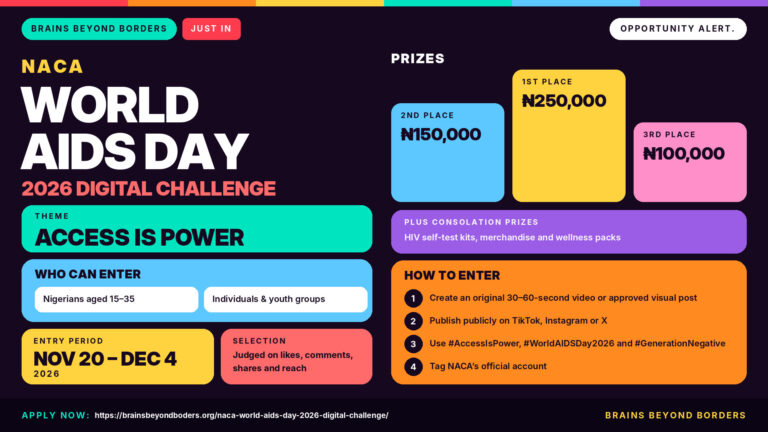 CompetitionsNaca World Aids Day 2026 Digital Challenge: Win ₦250,000 in the Access Is Power Competition.Nov 22, 2026
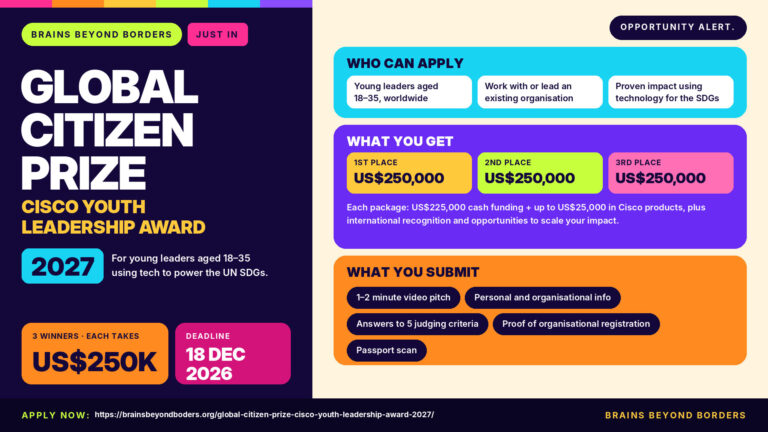 GrantsGlobal Citizen Prize Cisco Youth Leadership Award 2027: Win US$250,000 to Scale Your Impact.Nov 21, 2026
Join the Brains Beyond Borders Community
Get scholarships, tips and updates wherever you are.
WHO ORGANISES THE PROGRAMME?
The fellowship is jointly presented by two organisations.
UNITED NATIONS ACADEMIC IMPACT (UNAI)
UNAI is a United Nations initiative that connects higher education institutions with the UN and its work. It promotes the role of universities in advancing global priorities through education, research, civic engagement and the development of solutions to shared challenges.
MILLENNIUM CAMPUS NETWORK (MCN)
MCN is a nonprofit organisation focused on developing student leadership and supporting young people working towards social impact. Through the Millennium Fellowship, MCN provides a structured learning experience that helps students strengthen their projects, work collaboratively and build connections with other changemakers.
Together, the organisations use the fellowship to help undergraduate students turn their commitment to social change into practical, measurable action.
WHAT DOES THE FELLOWSHIP OFFER?
1. LEADERSHIP AND PROJECT DEVELOPMENT TRAINING
Fellows participate in a structured, experiential learning programme designed to strengthen their ability to lead projects and work effectively with others.
The curriculum includes areas such as:
– Developing empathy, humility and inclusive leadership.
– Setting SMART goals and planning measurable project outcomes.
– Preparing project budgets and managing resources.
– Team management, communication and project pitching.
– Evaluating challenges and improving project implementation.
– Giving and receiving feedback from fellow student leaders.
The training is intended to be applied directly to the Fellows’ projects throughout the programme.
2. GLOBAL NETWORKING AND PEER LEARNING
Fellows become part of a campus-based cohort and connect with other students working towards social change.
The fellowship encourages participants to exchange ideas, share lessons from their projects, identify common challenges and explore opportunities for collaboration. The wider MCN community also provides access to a global network of people interested in social impact.
3. PRACTICAL SOCIAL-IMPACT EXPERIENCE
Participants develop and implement a project addressing a relevant issue in their campus or wider community.
This gives Fellows an opportunity to practise leadership, coordinate activities, work with stakeholders and pursue measurable outcomes rather than limiting their participation to classroom learning.
4. CERTIFICATE OF RECOGNITION
Participants who successfully complete the programme’s project and graduation requirements receive a certificate of recognition jointly issued by the United Nations Academic Impact and the Millennium Campus Network.
The certificate is tied to successful completion. Selection alone does not guarantee that a participant will receive it.
5. OPPORTUNITIES TO STRENGTHEN YOUR LEADERSHIP PROFILE
The fellowship provides experience that students may be able to draw on in future leadership, community-development, academic and social-impact work. Participants also have the opportunity to document their projects and communicate the results of their work.However, the programme does not guarantee future scholarships, employment, grants or other awards.
[bbp_banner]
WHO IS ELIGIBLE TO APPLY?
The programme is open to eligible undergraduate students worldwide. Applicants should review the following requirements carefully.
1. AGE
Applicants must be at least 18 years old.
2. UNDERGRADUATE STATUS
Applicants must be enrolled undergraduate students at a college or university and remain undergraduate students in good standing throughout the programme. The fellowship is not open to students pursuing postgraduate degrees such as a master’s degree or PhD.
3. CONTINUED ENROLMENT THROUGHOUT THE PROGRAMME
Applicants must remain undergraduates throughout the Class of 2027 programme, scheduled for August to November 2027. Students who expect to graduate before 30 November 2027 are not eligible.
4. INTEREST IN SOCIAL IMPACT
Applicants should demonstrate a genuine interest in addressing challenges affecting their campus, community or society more broadly.
A strong application should communicate the problem the applicant wants to address, why it matters and how the proposed work could contribute to positive change.
5. COMMITMENT TO PARTICIPATION
Selected Fellows must be willing to participate in at least eight in-person fellowship sessions with other Fellows and Campus Directors on their campus.Applicants should consider whether their academic schedules and other commitments will allow them to meet this requirement.
6. A SOCIAL-IMPACT PROJECT OR PROJECT IDEA
Applicants need a project idea or an existing project they can develop through the fellowship. An established organisation or fully operational initiative is not necessarily required; a well-developed project idea can be considered.
WHAT KIND OF PROJECT CAN YOU PROPOSE?
The fellowship is designed for projects that address real challenges and advance the United Nations Sustainable Development Goals.
A qualifying project should:- Have a clear purpose and defined timeframe.
– Aim for meaningful, measurable results during the fellowship.
– Advance at least one Sustainable Development Goal.
– Advance at least one UNAI principle.
– Address a relevant issue affecting a campus or community.
Examples of possible projects include:
EDUCATION:
A campus initiative supporting learning access, literacy or educational inclusion.
HEALTH:
A community health-awareness or health-education initiative with measurable objectives.
ENVIRONMENT:
A campus sustainability project addressing waste management, environmental awareness or responsible resource use.
SOCIAL ENTERPRISE:
A student-led venture designed to address a community problem through a sustainable model.
RESEARCH AND ADVOCACY:
Research, student journalism or advocacy that contributes to understanding and addressing a social challenge.
CAMPUS LEADERSHIP:
An initiative through an existing student organisation that advances the SDGs.These are illustrative examples, not a complete official list. The suitability of a proposal depends on its objectives, feasibility and alignment with the fellowship’s requirements.
HOW TO MAKE YOUR PROJECT IDEA MORE COMPETITIVE
Before applying, think through five questions:
1. What problem are you addressing? Identify a specific issue rather than describing a broad ambition to change the world.
2. Who is affected? Define the people or community your project intends to serve.
3. What will you do? Describe practical activities that can be carried out during the fellowship.
4. How will you measure progress? Identify outcomes or indicators that can demonstrate whether the project is making a difference.
5. Which SDG and UNAI principle does it advance? Explain the connection between your proposed work and the programme’s goals.
For example, an applicant interested in educational access could propose a time-bound initiative to help a defined group of students access learning resources, with measurable participation and learning-support targets. The aim is to present a realistic, focused project that can make a meaningful contribution within the programme period.
HOW DOES THE FELLOWSHIP WORK?
The programme combines individual project development with collaborative campus-based learning.
STAGE 1: APPLICATION AND SELECTION
Applicants submit their initial application through the official fellowship website. The first round focuses on getting to know applicants and understanding their motivation for joining.Applications are reviewed on a rolling basis, so applicants are encouraged to apply early rather than wait until the priority deadline.
STAGE 2: SECOND-ROUND APPLICATION
Applicants who successfully pass Round 1 receive an invitation by email to complete Round 2.
The official application page identifies the following components for this stage:
– Details of the proposed or existing social-impact project.
– The applicant’s personal commitment to the cause.
– One academic or professional recommendation.
– An optional application to serve as a Campus Director.
The organisers state that Round 2 applications will open separately and that qualified applicants will be notified when further instructions are available. Applicants should follow the instructions sent to them rather than assume that every Round 2 document must be submitted with the initial application.
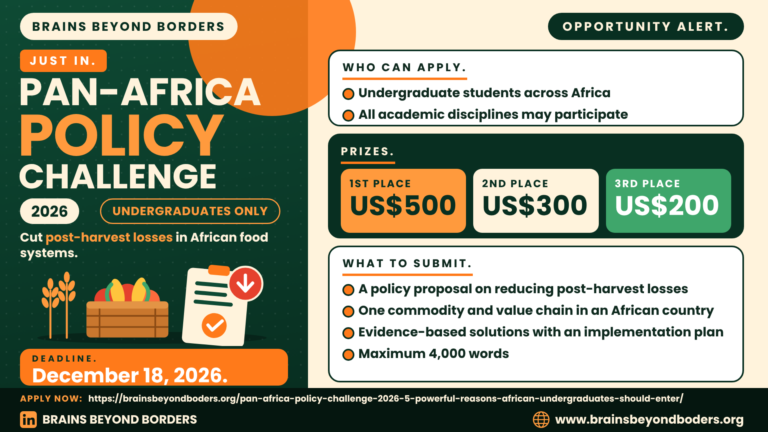 DuelsPan-Africa Policy Challenge 2026: 5 Powerful Reasons African Undergraduates Should Enter.Nov 21, 2026
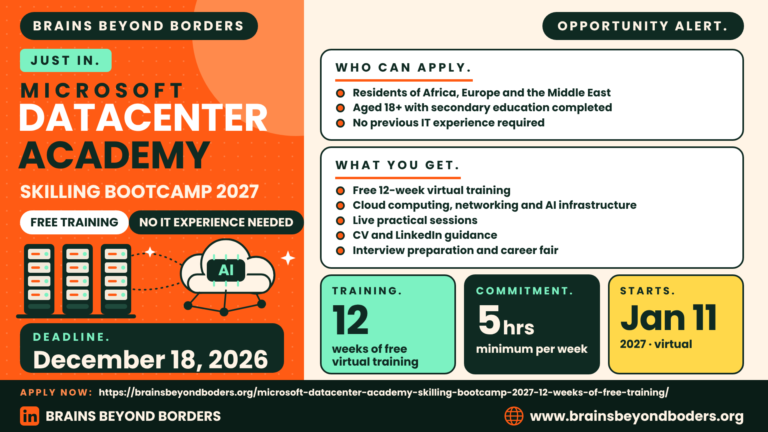 AI ToolsMicrosoft Datacenter Academy Skilling Bootcamp 2027: 12 Weeks of Free Training in Cloud Computing, AI Infrastructure and Networking.Nov 20, 2026
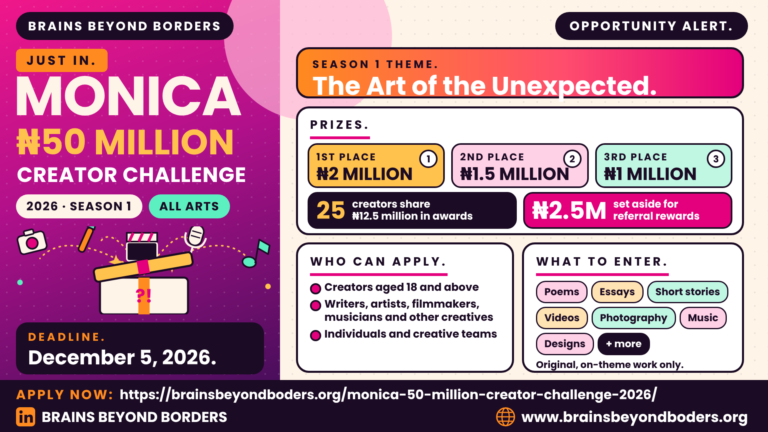 DuelsMonica ₦50 Million Creator Challenge 2026: The Guide for You to Apply and Win .Nov 20, 2026
 Free Training ProgrammesShe Leads Africa Boosther Program 2026: Free Digital Skills Training, Mentorship and Career Development for Young Nigerian Women.Nov 18, 2026
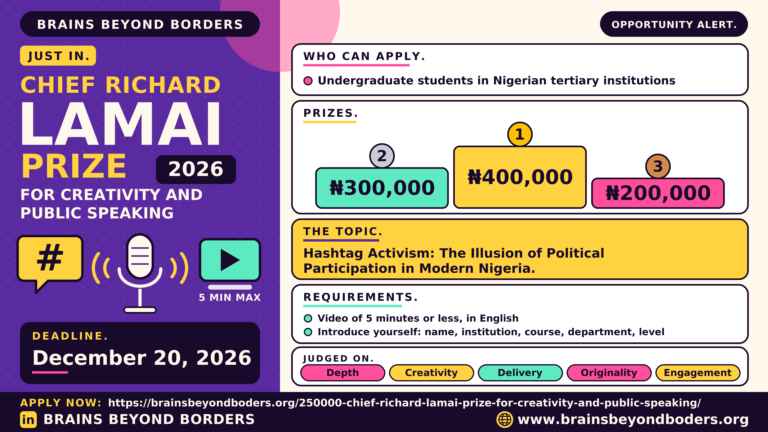 Competitions₦250,000 Chief Richard Lamai Prize for Creativity and Public Speaking 2026: How to Enter the 5-Minute Video Competition.Nov 18, 2026
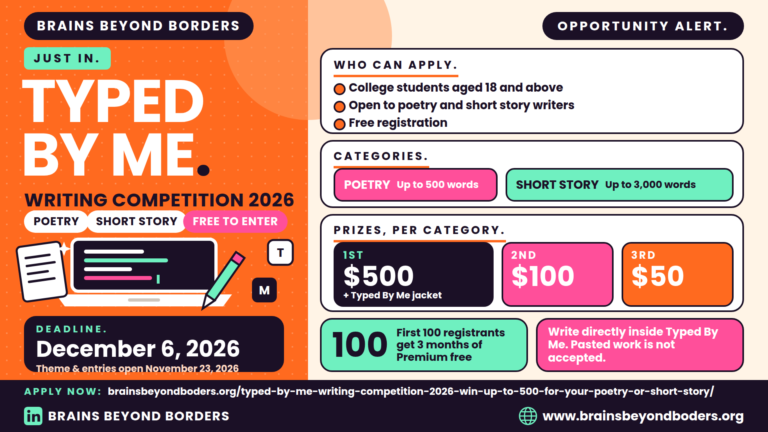 CompetitionsTyped by Me Writing Competition 2026: Win Up to $500 for Your Poetry or Short Story.Nov 17, 2026
STAGE 3: CAMPUS-BASED FELLOWSHIP SESSIONS
Selected Fellows participate in at least eight in-person sessions between August and November 2027.
During these sessions, participants work through the MCN Action Toolkit, receive feedback from peers, develop leadership skills and apply what they learn to their projects.The sessions are a core programme requirement, not an optional networking activity.
STAGE 4: PROJECT IMPLEMENTATION AND GRADUATION
Fellows work towards the outcomes established for their projects and fulfil the programme’s graduation requirements. Successful completion leads to a certificate of recognition from UNAI and MCN. Fellows may also be encouraged to share their project results and lessons learned.
STAGE 5: ALUMNI NETWORK
After completing the fellowship, participants can remain connected to the broader MCN community. Alumni are encouraged to continue advancing social impact, support future student leaders and maintain connections with their campus communities.
CAMPUS ELIGIBILITY: AN IMPORTANT DETAIL
The Millennium Fellowship is organised through selected campus cohorts, rather than operating solely as an individual award detached from a university community.According to the official programme website, a campus must have at least eight selected Millennium Fellows to form an eligible cohort. The organisers describe 15–20 or more as a competitive campus applicant pool.
This has practical implications for applicants:
– Your own eligibility does not automatically mean your campus will be selected.
– Selection depends on the number and quality of applications received from your campus, alongside the organisers’ selection process.
– You are encouraged to share the opportunity with eligible undergraduate classmates.
– A campus cohort generally includes Fellows and Campus Directors who help coordinate the programme locally.If you are interested in bringing the fellowship to your university, encourage suitable classmates to apply and consider whether your campus can build a committed group of participants.
IS THE MILLENNIUM FELLOWSHIP FULLY FUNDED?
The fellowship is free to participate in, and the organisers state that there is no programme fee charged to selected students or participating universities.However, it is important to distinguish a free leadership programme from a conventional fully funded scholarship.
The official programme describes benefits such as training, networking, project-development support and a certificate of recognition. It does not advertise a standard cash award or promise tuition payments as part of the fellowship.Applicants should therefore not assume that the programme will cover accommodation, transport, meals, personal expenses or other costs associated with attending campus sessions. If you need clarification about a particular expense, contact the organisers directly before making financial commitments.
HOW TO APPLY
Applications for the Millennium Fellowship Class of 2027 are submitted online.
STEP 1: VISIT THE OFFICIAL APPLICATION PAGE
Go to the official Millennium Fellowship application website HERE.
STEP 2: READ THE ELIGIBILITY REQUIREMENTS
Confirm that you meet the age, undergraduate enrolment and continued-study requirements. Check that you can participate in the required in-person sessions during the fellowship period.
STEP 3: BEGIN ROUND 1
Select the application option on the official page and complete the initial application, which focuses on your background and motivation for joining the fellowship.
STEP 4: EXPLAIN YOUR MOTIVATION CLEARLY
Be prepared to explain your interest in social impact and why you want to participate. Think about the problem you want to address and the contribution you hope to make.
STEP 5: SUBMIT BEFORE THE PRIORITY DEADLINE
Review your answers for completeness and accuracy before submitting. The official website states that applications are reviewed on a rolling basis, so applying early is encouraged.
STEP 6: MONITOR YOUR EMAIL
If you pass Round 1, the organisers will invite you by email to complete Round 2. Follow the instructions provided for project details, the recommendation and any other required information.
STEP 7: PREPARE TO PARTICIPATE
If selected, ensure that you can attend the required in-person sessions and work on your project throughout the fellowship period.
ARE THERE APPLICATION FEES?
No. The organisers state that the Millennium Fellowship is free for selected participants and that there is no fee charged to students or universities. Apply through the official website and be cautious of anyone claiming to sell access to the fellowship or guarantee selection in exchange for payment.
APPLICATION DEADLINE
The next priority deadline for the Millennium Fellowship Class of 2027 is: 31 OCTOBER 2026, AT 11:59 P.M. EASTERN TIME.
Applications are reviewed on a rolling basis, and the official website encourages early submission for the limited number of available fellowships.The date above is the priority deadline stated by the organisers. Applicants should consult the official application page for any subsequent updates.
OFFICIAL LINKS AND ENQUIRIES
• Access The Official application page HERE.
• Access The Official programme information HERE.
• Access The Frequently asked questions HERE.
• Application enquiries and technical support: [email protected]
FINAL NOTES FOR APPLICANTS
The Millennium Fellowship may be particularly relevant to undergraduate students who want to move beyond discussing social problems and begin developing practical solutions with measurable outcomes.
Before applying, ensure that you meet the eligibility requirements, can remain an undergraduate through the programme period, have a credible project idea and are able to attend the required in-person sessions.
The fellowship is free, but selection is competitive and campus participation is not automatic. Read the official guidelines carefully, submit your application early and monitor your email for any second-round instructions.
APPLICATION STATUS: OPEN.
PRIORITY DEADLINE: 31 OCTOBER 2026.
Join the Brains Beyond Borders Community
Get scholarships, tips and updates wherever you are.