INTERNET SOCIETY FELLOWSHIP PROGRAM 2026.
The Internet Society Fellowship Program is a 10-month learning and leadership programme designed for Internet changemakers and emerging leaders who want to turn locally grounded ideas into practical projects that strengthen the Internet and create lasting impact in their communities.
The redesigned programme combines structured online learning, leadership development, mentorship, project implementation, expert engagement and participation in relevant global or regional Internet events.
For the 2027 fellowship cycle, the programme will welcome 90 fellows across its three major tracks.
 ScholarshipsOsj Foundation Undergraduate STEM Scholarship 2026: Full Scholarship, Accommodation and Monthly Stipend at the University of Ibadan.Nov 24, 2026
 ScholarshipsAnfi Foundation Scholarship Fund Program 2027.Nov 24, 2026
 ResourcesHow to Write a Winning Personal Statement for a Scholarship: A Practical Guide with Examples for Students.Nov 23, 2026
 ScholarshipsJim Ovia Foundation Scholarship 2026: How to Get ₦250,000 Annually and Apply Before the Deadline.Nov 23, 2026
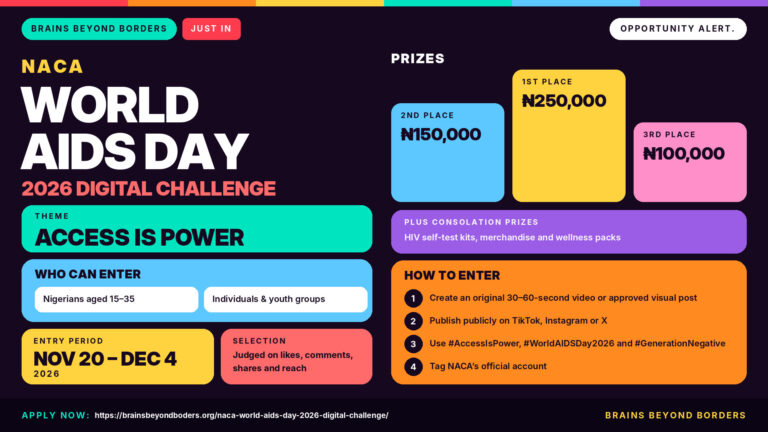 CompetitionsNaca World Aids Day 2026 Digital Challenge: Win ₦250,000 in the Access Is Power Competition.Nov 22, 2026
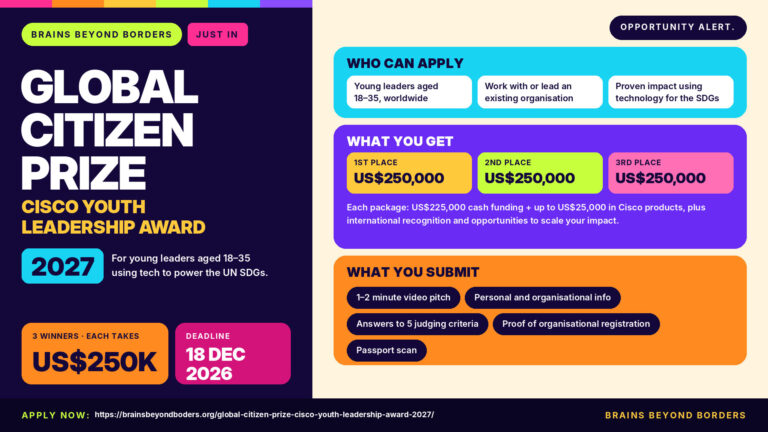 GrantsGlobal Citizen Prize Cisco Youth Leadership Award 2027: Win US$250,000 to Scale Your Impact.Nov 21, 2026
ABOUT THE INTERNET SOCIETY FELLOWSHIP PROGRAM
The programme is built around the idea that meaningful Internet development requires people who understand local challenges and can translate that understanding into practical action.
Rather than being solely an academic or training programme, the Fellowship places a strong emphasis on real-world project implementation.
Every selected fellow is expected to design and implement a practical project that advances the Internet in their community, country, region or area of expertise.
The fellowship project runs for six months and may result in outputs such as policy briefs, research reports, training programmes, community initiatives, workshops, technical resources, implementation plans, awareness campaigns, toolkits or other practical deliverables.
WHO THE INTERNET SOCIETY IS LOOKING FOR
The programme is looking for individuals who demonstrate the following qualities:
– Locally rooted and globally aware: Applicants should understand local challenges while connecting them to broader Internet governance, connectivity, security, trust and safety issues.
– Action-oriented and impact-driven: Applicants should demonstrate a focus on practical change rather than purely theoretical or academic work.
– Collaborative and multistakeholder-minded: Applicants should be comfortable working across communities, civil society, government, industry and technical groups.
– Strong communicators: Applicants should be able to explain complex technical, policy or security concepts clearly to different audiences.
– Evidence-based and strategic: Applicants should use data, analysis and sound reasoning to identify opportunities and guide action.
– Committed to long-term public benefit: Applicants should demonstrate a sustained interest in advancing an open, trustworthy and inclusive Internet.
FELLOWSHIP TRACKS AND SUB-TRACKS
The programme has three main tracks, each with two specialised sub-tracks.
• INTERNET POLICY AND MOBILIZATION
This track focuses on developing advocates who can influence Internet policy and mobilise communities for local impact.
Sub-tracks includes Internet Policy and Community Mobilization.
• INTERNET CONNECTIVITY
This track focuses on technical and community-based approaches to improving Internet connectivity and infrastructure.
Sub-tracks includes Peering, Community-Centered and Connectivity.
• INTERNET SAFETY AND SECURITY
This track develops cybersecurity researchers and online safety champions.
Sub-tracks includes Systems Security, Online Trust and Safety.
Applicants select one track and sub-track per cycle.
The choice should correspond with the applicant’s interests, experience and proposed project.
WHAT IS THE PRE-FELLOWSHIP TRAINING?
An important part of the application process is the Pre-Fellowship Training.
This is a series of self-paced online courses designed to prepare prospective fellows with foundational Internet knowledge, track-specific expertise and project-development skills.
The training is expected to take approximately 30 hours, excluding the additional time required to develop the proposed project.
The training includes foundational areas such as The Internet ecosystem, Internet governance, Leadership, Advocacy, Communications, Project management, Internet impact, Grant application and project implementation.
Depending on the selected track and sub-track, applicants may also complete specialised courses covering areas such as encryption, community networks, peering, Internet security, online trust and safety, and other relevant topics.
IMPORTANT: TRAINING IS NOT AUTOMATIC FELLOWSHIP SELECTION
Completing the Pre-Fellowship Training does not make someone a fellow automatically.
Participants who complete the required training become eligible to apply for the Fellowship Program. They must then submit a separate fellowship application and go through a competitive selection process.
The Internet Society states that selection considers factors including the applicant’s background and expertise as well as the quality, feasibility and potential impact of the proposed project.
However, completing the training does provide participants with specialised knowledge, a certificate of completion and a practical project plan that can potentially be pursued independently or refined for a future application.
FELLOWSHIP BENEFITS
Selected fellows receive a range of support throughout the programme.
• DEDICATED MENTORSHIP
Each fellow receives a dedicated mentor whose expertise aligns with the fellow’s project area and selected track or sub-track.
• PROJECT STIPEND
Fellows may apply for a project stipend of up to USD $5,000.
The funding is subject to submission and approval of the proposed project budget and is intended for justified direct project costs.
Examples provided by the Internet Society include workshop expenses, printing, local transport, minor equipment hire and other costs directly related to project implementation. The stipend is not personal compensation and cannot be used to pay salaries or consulting fees.
• TRAVEL SUPPORT
Selected fellows receive travel support to attend a relevant global or regional Internet event, depending on their track and programme requirements.
Examples of relevant events include the Internet Governance Forum (IGF), AfPIF and the NDSS Symposium.
• GLOBAL NETWORK
Fellows become part of a global network of Internet leaders and gain access to the Internet Society Alumni Network after completing the programme.
FELLOWSHIP PROJECT
The practical project is at the centre of the programme.
Each fellow is expected to develop and implement a project that addresses a real Internet-related challenge within their community, country, region or area of expertise.The six-month implementation period allows fellows to apply the knowledge and skills gained during training while working toward measurable outcomes.
Possible project outputs include:
– Policy initiatives.
– Research projects.
– Community campaigns.
– Training programmes.
– Technical deployments.
– Practical tools.
– Policy briefs.
– Research reports.
– Workshops.
– Toolkits.
– Awareness campaigns.
– Implementation plans.
Projects are expected to have clear objectives, activities, deliverables and intended outcomes, with progress reporting and final outputs used to demonstrate their impact.
APPLICATION REQUIREMENTS
Before applying for the Fellowship Program, prospective applicants must complete the required Pre-Fellowship Training.
Applicants should also be prepared to meet the following requirements:
– Select one fellowship track and sub-track.
– Complete all required Pre-Fellowship Training modules.
– Develop a realistic, locally grounded project plan aligned with the Internet Society’s mission.
– Demonstrate a high level of English reading, speaking and writing proficiency.
– Have reliable Internet access throughout the programme.
– Have suitable equipment for virtual training sessions and calls.
– Be able to dedicate a minimum of four hours per week during the 10-month programme.
– Hold a valid passport that remains valid for at least six months beyond anticipated fellowship-related travel dates.
– Not currently be participating in the 2026 Internet Society Fellowship.
APPLICATION PROCESS
The application process is different from a conventional fellowship application because candidates must first complete the required training.
• STEP 1: ENROL IN THE PRE-FELLOWSHIP TRAINING
Select the track and sub-track that best match your interests, experience and proposed project.
• STEP 2: COMPLETE THE REQUIRED MODULES
All required Pre-Fellowship Training modules must be completed before the fellowship application can be submitted.
• STEP 3: RECEIVE THE FELLOWSHIP APPLICATION LINK
Once completion of the required training has been confirmed, eligible participants will receive the actual Fellowship Program application link by email within 24 hours.
•STEP 4: SUBMIT THE FELLOWSHIP APPLICATION
Eligible participants can submit their fellowship application as soon as they receive the application link.S
• STEP 5: SELECTION
Applications undergo review and selection.
• STEP 6: FELLOWSHIP OFFER
Successful applicants receive their fellowship outcome and acceptance information.
• STEP 7: BEGIN THE FELLOWSHIP
Selected fellows proceed to onboarding and the full fellowship programme.
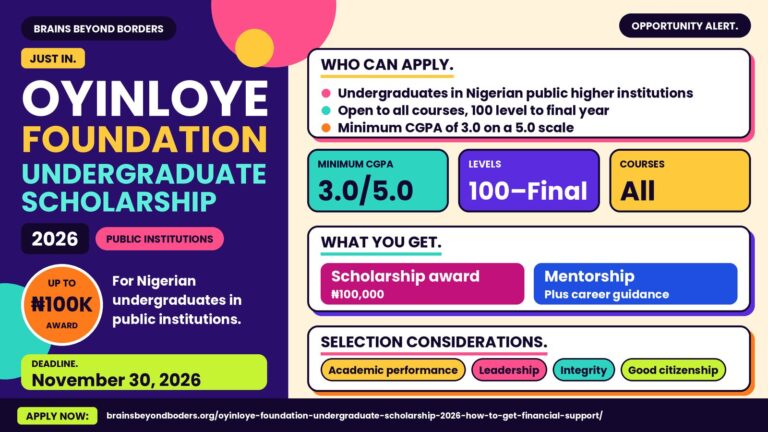 ScholarshipsOyinloye Foundation Undergraduate Scholarship 2026: How to Get ₦100,000 in Financial Support.Nov 21, 2026
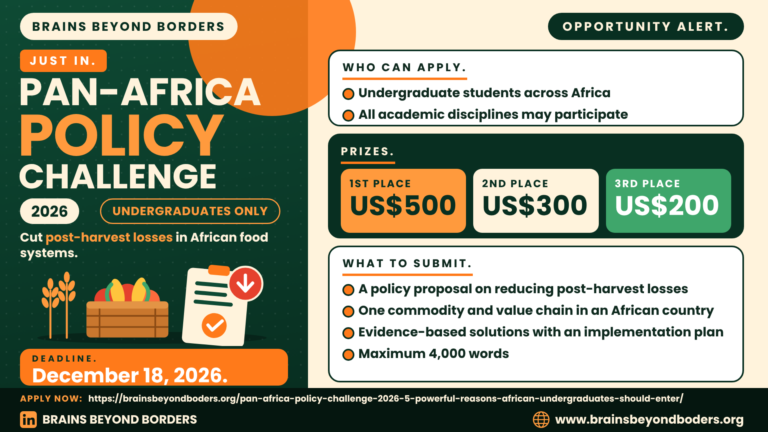 DuelsPan-Africa Policy Challenge 2026: 5 Powerful Reasons African Undergraduates Should Enter.Nov 21, 2026
 AI ToolsMicrosoft Datacenter Academy Skilling Bootcamp 2027: 12 Weeks of Free Training in Cloud Computing, AI Infrastructure and Networking.Nov 20, 2026
 DuelsMonica ₦50 Million Creator Challenge 2026: The Guide for You to Apply and Win .Nov 20, 2026
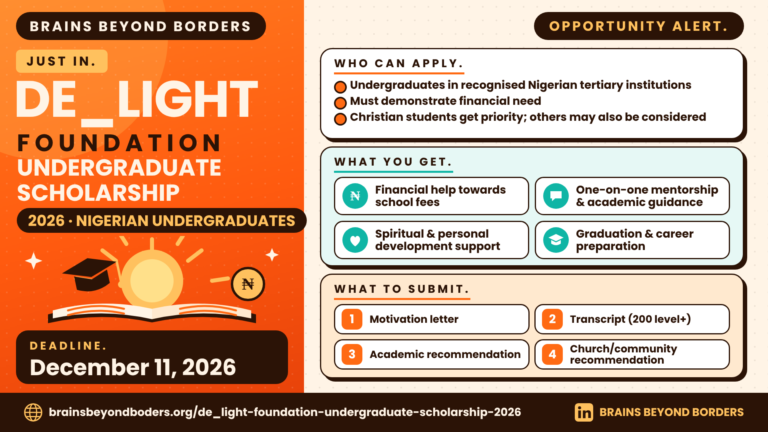 ScholarshipsDe_Light Foundation Undergraduate Scholarship 2026: Financial Support and Mentorship for Nigerian Students.Nov 18, 2026
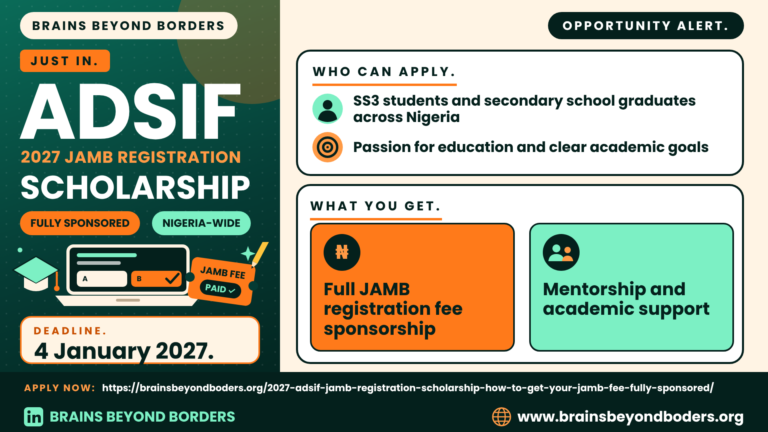 Scholarships2027 ADSIF JAMB Registration Scholarship: How to Get Your JAMB Fee Fully Sponsored.Nov 18, 2026
IMPORTANT DEADLINES
The Pre-Fellowship Training enrollment period runs from September 23 to November 22, 2026.
All required training modules must be completed by November 22, 2026 in order for a participant to become eligible to receive the fellowship application link.
The separate Fellowship Program application remains open on a rolling basis after applicants complete their training, with the final application deadline being December 18, 2026.
KEY DATES
– September 23, 2026: Pre-Fellowship Training opens.
– November 22, 2026: Required training must be completed.
– December 18, 2026: Fellowship applications entirely close.
– December 21, 2026 – January 29, 2027: Application review and selection.
– February 19, 2027: Fellowship notifications and acceptance.
– February 22, 2027: Fellowship kick-off and onboarding.
– June 1 – November 30, 2027: Mentored project implementation.
– December 3, 2027: Final project delivery.
– Early December 2027: Graduation ceremony.
IMPORTANT NOTE ABOUT THE APPLICATION LINK
The Pre-Fellowship Training enrollment and the actual Fellowship Program application are not the same thing.The Internet Society states that participants must first complete the required training. Once completion is confirmed, eligible participants receive the fellowship application link by email within 24 hours.Therefore, applicants should begin through the official Fellowship page and enroll in the required Pre-Fellowship Training rather than looking for a conventional fellowship application form immediately.
USE OF GENERATIVE AI
The Internet Society does not prohibit the use of generative AI tools when preparing fellowship applications, but it states that AI should be used only as a supporting resource, such as for translation, grammar correction or accessibility needs.
Applicants are expected to use their own words and ideas, and all information submitted must accurately and truthfully represent their experience, expertise and project vision.
Applicants are also advised not to enter confidential or personally identifiable information into public AI tools.
WHO SHOULD CONSIDER THIS FELLOWSHIP?
This opportunity is particularly relevant to people already working on, studying or developing practical ideas related to:
– Internet policy and governance.
– Community mobilisation.
– Internet infrastructure.
– Community-centred connectivity.
– Peering.
– Cybersecurity.
– Systems security.
– Online safety and trust.
– Digital rights.
– Internet access and inclusion.
– Internet-related research and advocacy.
The programme is designed around practical Internet challenges and measurable community impact, so prospective applicants should think beyond simply describing an interest in technology and instead consider what concrete Internet-related problem they could realistically address through a structured project.
OFFICIAL APPLICATION LINKS
• Apply For The Internet Society Fellowship Program HERE.
• Access The FAQs and their respective answers HERE.
• Access The Fellowship Tracks and Pre-Fellowship Training Opportunities HERE.
[bbp_banner]